
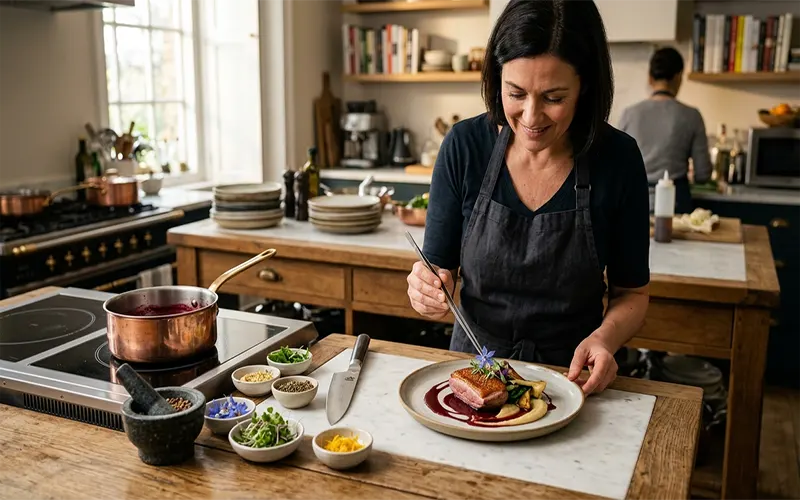
The transition from a “home cook” to a “culinary artist” is not measured by the complexity of the recipes one follows, but by a fundamental shift in mindset. Cooking is the act of following instructions; culinary art is the mastery of variables—heat, time, chemistry, and organization. In a professional kitchen, a chef doesn’t just aim for “tasty”; they aim for a repeatable, balanced, and textures-rich experience.
Achieving restaurant-quality results at home rarely requires industrial-grade ovens or expensive gadgetry. Instead, it demands a commitment to the foundational principles that have governed professional kitchens for centuries. By understanding the why behind the how, you can move beyond the constraints of a written recipe and begin to cook with intuition. Whether you are searing a simple chicken breast or whisking a delicate emulsion, the difference between a mediocre meal and a memorable one lies in the precision of your technique.
The Foundation: Mise en Place & Knife Skills
In the professional world, the most important tool isn’t a stove—it’s a philosophy. Mise en Place, a French term meaning “everything in its place,” is the practice of prepping all ingredients and tools before the first flame is lit. To a chef, organization is a direct flavor-enhancer. When your aromatics are minced, your proteins are tempered to room temperature, and your liquids are measured, you are free to focus entirely on the transformation of the food in the pan. This prevents the “panic-chopping” that leads to overcooked garlic or scorched butter.
Supporting this organization is the mastery of Knife Skills. Precision in cutting isn’t just about aesthetics; it is a mechanical necessity for even cooking. If your carrot coins vary in thickness, the thin pieces will turn to mush while the thick ones remain crunchy. Mastering the brunoise (1/8-inch cubes) or the julienne (matchsticks) ensures that every morsel in the dish has a uniform mouthfeel and cooks at the exact same rate. Furthermore, a sharp knife preserves the cellular structure of your ingredients—a dull knife crushes herbs like basil, causing them to oxidize and turn black, whereas a sharp blade slices through the cells, keeping the flavor and color vibrant.
The Science of Sear: Mastering Heat
One of the most profound differences between home and professional cooking is the courageous use of heat. Many home cooks are afraid of the “hiss” of a hot pan, but heat is where the magic happens—specifically, the Maillard Reaction. This is the chemical reaction between amino acids and reducing sugars that gives browned food its distinctive, savory flavor.
To achieve a professional sear, two things are non-negotiable: surface moisture and pan temperature. A chef will always pat a protein bone-dry with paper towels; if there is moisture on the surface, the heat of the pan will first go toward evaporating that water (steaming the meat) rather than browning the surface. Once dry, the protein must hit a pan that has reached its smoke point.
Do not be afraid of the fond—the concentrated, brown bits of caramelized protein stuck to the bottom of the pan after searing. In a professional kitchen, this is liquid gold. By deglazing the pan with a splash of wine, stock, or even vinegar, you lift those browned bits into a sauce, creating a depth of flavor that is impossible to achieve through simmering alone.
The Balancing Act: Salt, Fat, Acid, Heat
If a dish tastes “flat” or “boring,” the instinctive reaction is often to add more salt. However, a professional palate knows that the missing link is almost always Acid. While salt enhances existing flavors, acid (lemon juice, vinegar, wine) acts as a high-frequency note that cuts through richness and brightens the entire dish.
Learning to “adjust seasoning” at the finish is what separates the line cook from the executive chef. When you taste your meal before serving, ask yourself four questions:
- Is it heavy or dull? Add Acid.
- Is it too sharp or thin? Add Fat (a knob of butter or a drizzle of oil).
- Is it one-dimensional? Add Salt (to pull out the flavors).
- Does it lack depth? Add Heat or Umami (a drop of soy sauce or Worcestershire).
This “balancing act” happens in the final thirty seconds. A simple squeeze of lime over a heavy beef stew or a splash of red wine vinegar in a lentil soup can transform a heavy, muddy flavor profile into something vibrant and electric.
Professional Finishing Touches: The Art of the Reveal
The meal is not finished when the heat is turned off. The final five minutes are critical for texture and presentation. One of the most classic professional techniques is Monter au Beurre (mounting with butter). By whisking a few cubes of cold, unsalted butter into a sauce at the very end—away from the heat—you create a glossy, velvet-like emulsion that coats the back of a spoon. If the butter is added too early or over too high a heat, the emulsion will break, leaving you with a greasy puddle rather than a professional sauce.
Furthermore, Resting Meat is an absolute requirement. In a professional kitchen, a steak or roast is rested for at least half of its total cooking time. This allows the muscle fibers, which tightened under the heat, to relax and reabsorb the juices. Slicing too early results in all that flavor-rich moisture running out onto the cutting board, leaving the meat dry and gray.
Finally, consider the Rule of Thirds for plating. Professional plating focuses on height, color contrast, and “negative space.” Instead of filling the plate from edge to edge, center the food and leave the borders clean. Use a damp cloth to wipe away any stray drips of sauce. When you treat the plate like a canvas, you signal to your guests—and yourself—that the meal is an experience worth savoring.
Elevating your home cooking is not about luck; it is about the intentional application of science and discipline. By adopting the habits of Mise en Place, respecting the power of the Maillard Reaction, and learning to balance flavors with Acid, you bridge the gap between sustenance and soul-satisfying cuisine. These techniques transform the daily chore of the kitchen into a creative practice, allowing you to produce meals that don’t just fill a plate, but tell a story of craft and care.