
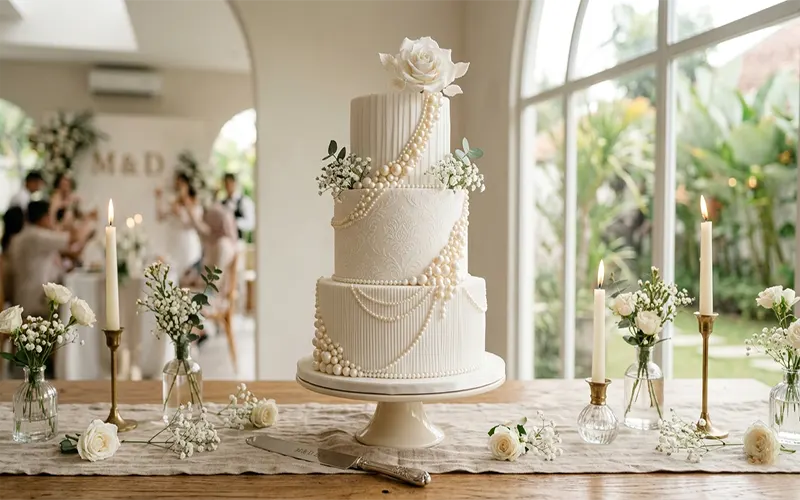
In the world of bridal design, trends are often fleeting, rising and falling with the seasons. However, the all-white wedding cake remains a steadfast icon of “Quiet Luxury.” It is a design choice that requires no bold colors to command a room; instead, it relies on the understated power of monochromatic depth. While a multicolored cake tells a story through contrast, an all-white cake tells its story through the subtle interplay of light and shadow.
Choosing a “simple” white cake does not equate to choosing a “plain” one. In fact, a monochromatic palette shifts the focus entirely onto the craftsmanship of the baker. Without the distraction of color, every detail—from the sweep of the spatula to the placement of a single pearl—becomes a focal point. This aesthetic is for the couple who appreciates “Minimalist Opulence,” a future-proof design that feels as relevant today as it will in the photographs viewed fifty years from now.
The Art of White-on-White Texture
When you remove color from a design, texture becomes your primary language. To prevent an all-white cake from looking like a flat, featureless monolith, professional designers use “white-on-white” layering to create visual intrigue.
Bas-Relief
Inspired by classical architecture and carved plasterwork, the Bas-Relief technique involves applying molded sugar elements—usually floral or botanical—directly onto the side of the cake. When these elements are the exact same shade of white as the background, they create a stunning, three-dimensional effect. As the reception lighting shifts throughout the evening, the shadows cast by the raised patterns deepen, making the cake look like a piece of sculpted marble.
Ripped Wafer Paper
For a more modern, ethereal look, many designers are turning to Wafer Paper. By tearing or “ripping” thin sheets of edible paper and layering them around the tiers, you create a soft, deckled edge that mimics the delicate movement of white silk or ostrich feathers. This texture adds an “airy” quality to the cake, making it feel light and romantic rather than heavy and structured.
Swiss Dot & Linear Piping
For the traditionalist, the Swiss Dot remains a hallmark of elegance. By piping tiny, uniform pearls of frosting in a grid or a cascading pattern, you add a tactile “fabric” feel to the cake. Modern minimalism often takes this further with Linear Piping—perfectly straight, vertical lines of frosting that run the height of the tier, creating a sleek, “pinstripe” effect that elongates the cake and adds a touch of architectural rigor.
Incorporating Pearls: The “Pearl-Core” Aesthetic
The return of the pearl in fashion and interior design has naturally translated into the “Pearl-Core” cake trend. Pearls symbolize purity, wisdom, and timelessness, making them the perfect accompaniment to an all-white design.
- The “Cascade”: This technique involves using sugar pearls of varying sizes—from tiny “nonpareils” to large “dragees”—and scattering them so they appear to be “falling” from the top of the cake. The randomness of the cascade feels organic and whimsical, breaking up the formal lines of the tiers with a shimmering, stardust effect.
- The Border: For a look of “Chanel-inspired” sophistication, a singular, perfect line of medium-sized pearls is placed at the very base of each tier. This acts as a “jewelry finish,” framing the cake and giving it a grounded, regal appearance.
- The Cluster: Instead of a scattered look, pearls can be concentrated in a single, sculptural cluster. This creates a focal point—perhaps on the middle tier—that looks like a brooch or a piece of high-fashion embroidery.
Playing with Light and Finish
The “white” of your cake is rarely just one flat shade. The finish of the frosting dictates how the cake interacts with the camera and the venue’s lighting.
Matte Fondant vs. Lustre-Dusted Buttercream
A Matte Fondant finish provides a clean, contemporary, and almost “velvet” look. It absorbs light, which makes the textures of pearls and bas-relief stand out with high-definition clarity. On the other hand, a Lustre-Dusted Buttercream adds a subtle pearlescent glow. This finish reflects light, giving the cake an “inner radiance” that works beautifully in candlelight or sun-drenched outdoor settings.
When selecting your pearls, consider the contrast between Iridescent and Opaque. Iridescent pearls have a rainbow-like sheen that adds movement, while Opaque pearls provide a creamy, solid finish that feels more “Old World” and traditional.
Flavor Pairings for All-White Cakes
The internal profile of an all-white cake should match its visual serenity. You want flavors that feel “clean” and sophisticated, avoiding heavy, dark fillings that might bleed through a semi-naked finish or feel too “heavy” for the aesthetic.
- White Chocolate & Raspberry: A silky, sweet white chocolate ganache paired with a tart, clear raspberry gelée.
- Champagne & Vanilla: A light-as-air sponge infused with the effervescent notes of champagne, paired with a classic Madagascan vanilla bean buttercream.
- Almond & Coconut: A nutty, fragrant combination that feels tropical yet refined, often paired with a thin layer of apricot preserve for a hidden brightness.
An elegant all-white cake is a masterclass in restraint. It proves that you don’t need a loud color palette to make a memorable statement. By focusing on the “unspoken details”—the ripple of a wafer paper edge, the architectural precision of a pearl border, and the way light dances across a bas-relief floral—you create a centerpiece that is the embodiment of grace. It is a “future-proof” design that transcends time, ensuring that when you look back at your wedding day, the beauty of your cake remains as vivid and classic as the day you said “I do.”