
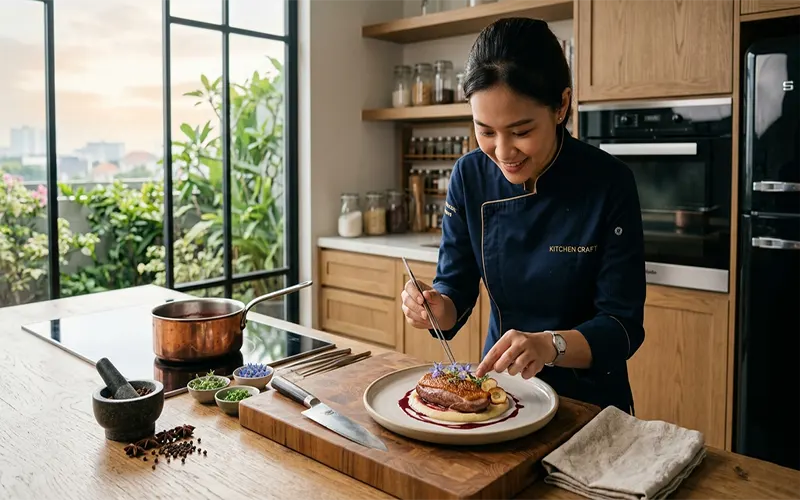
Transitioning from the high-octane environment of a commercial line to the intimate setting of a private home is a profound shift in the life of a culinarian. In a restaurant, you are a cog in a high-speed machine, cooking for an anonymous crowd of “covers.” As a Personal Chef, you are invited into a client’s private sanctuary. You become a steward of their health, a curator of their celebrations, and a silent observer of their daily lives.
The role requires a unique blend of high-level technical prowess and extreme versatility. You are no longer specialized in a single station; you are the executive chef, the sous chef, the dishwasher, and the server all at once. Success in this field isn’t just about the ability to execute a perfect demi-glace; it’s about the ability to adapt your craft to the specific, evolving needs of a single household. To thrive, you must master a set of “invisible” skills that traditional culinary schools often overlook.
The “Invisible” Technical Skills: Adaptability is King
In a restaurant, every burner, knife, and cutting board is exactly where you expect it to be. In a private home, you are at the mercy of the client’s kitchen. One day you might be working with a professional-grade Wolf range, and the next, you’re navigating an older induction cooktop with a limited set of non-stick pans.
Kitchen Adaptability
A great personal chef must be able to produce five-star results regardless of the equipment. This means mastering Heat Management across various surfaces and knowing how to compensate for “hot spots” in a residential oven. You must become adept at bringing your own “go-bag”—a curated set of your own knives, a digital thermometer, and perhaps a favorite cast-iron skillet—to ensure consistency in an unfamiliar environment.
Mise en Place for Travel
One of the most critical logistical skills is Mobile Preparation. Many personal chefs utilize a “commissary” or commercial kitchen for heavy prep—chopping, stock-making, and par-boiling—and then transport the components to the client’s home for the final “finish.” Mastering the art of staggered cooking—knowing exactly what can be prepped ahead without losing texture and what must be executed à la minute in the residential kitchen—is the hallmark of a professional.
Food Safety in a Non-Standard Environment
Managing cross-contamination in a residential kitchen requires heightened vigilance. You are often working in a space where family members (and pets) may be moving around. Aspiring personal chefs must be experts in HACCP principles but applied to the home: maintaining strict “cold chain” logistics during transport and ensuring that “clean” and “dirty” zones are strictly maintained in a multi-use domestic space.
Menu Engineering & Dietary Fluency
In the private sector, you are rarely hired to cook “whatever you want.” You are hired to solve a problem—whether that is a lack of time, a health goal, or a complex set of medical requirements. To be successful, you must become a Nutritional Chameleon.
Aspiring personal chefs must possess deep fluency in modern dietary protocols. It is no longer enough to offer a “vegetarian option.” You must understand the nuances of Keto, Paleo, Low-FODMAP, Whole30, and Vegan lifestyles. Furthermore, you must be a master of Allergy-Safe Cooking, understanding the hidden sources of gluten, soy, or nightshades.
The challenge lies in maintaining culinary integrity while adhering to these constraints. Can you make a Keto-friendly dessert that doesn’t taste like chemicals? Can you create a salt-free meal for a client with hypertension that still explodes with flavor through the use of acids and aromatics? This is where your true value lies.
The Art of Discretion and Service: The “Ghost Presence”
Perhaps the most difficult skill to teach is the “Soft Skill” of client interaction. As a personal chef, you are a service professional in a high-stakes environment. You must possess Emotional Intelligence (EQ) to read the room.
Active Listening and Feedback
Unlike a restaurant, where feedback comes through a server or a Yelp review, your feedback is immediate and personal. You must be able to take criticism of your “signature dish” with grace and pivot your style to match the client’s palate. If they want their steak “well-done” and their pasta “soft,” your job is to provide the highest-quality version of their preference, not to lecture them on Italian tradition.
The Ghost Presence
There is a delicate balance between being a friendly, engaging presence and being “invisible.” Some clients want to chat and learn your techniques; others want you to be a ghost who leaves behind a clean kitchen and a fridge full of labeled containers. Developing the intuition to know when to engage and when to retreat is essential for long-term client retention.
Business and Logistics: The Chef-Entrepreneur
When you go private, you are no longer just a cook; you are a small business owner. The “back of house” now includes your car, your laptop, and your local grocery stores.
Strategic Sourcing and Costing
You must master Micro-Sourcing. This involves building relationships with local butchers, fishmongers, and farmers’ markets to find the absolute best ingredients while maintaining a strict budget. Effective Food Costing is vital; if you overspend on ingredients, you are effectively paying the client to eat your food.
Time Management and Scaling
One of the most common tasks for a personal chef is the “Cook Day”—preparing five days’ worth of meals in a single four-hour window. This requires Advanced Batch Cooking skills and a deep understanding of how different foods hold up to reheating. You must engineer your menus so that the Monday meal is as fresh as the Friday meal, utilizing vacuum-sealing and specific storage techniques to maintain quality.
The journey of an aspiring personal chef is one of constant learning and profound reward. While the technical skills of the culinary arts provide the foundation, it is your adaptability, dietary expertise, and “soft” service skills that will build your reputation. In this role, you aren’t just feeding people; you are improving their quality of life. The greatest reward is the trust a client places in you—a trust that is earned one perfectly executed, deeply personal meal at a time.