
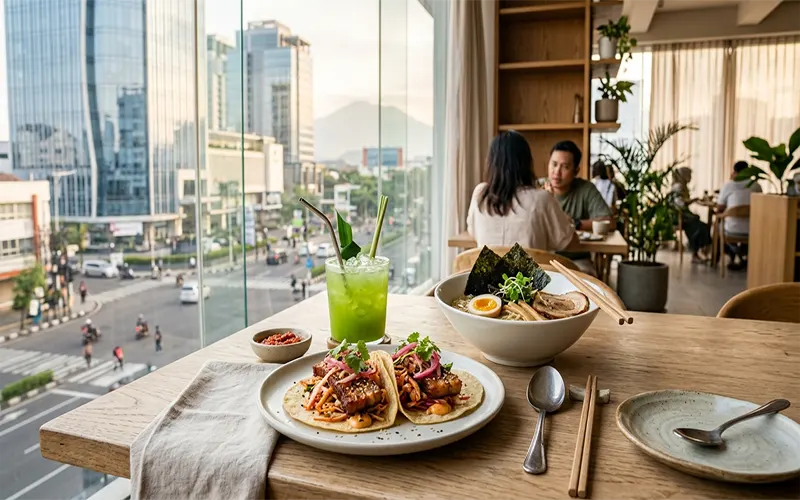
In the late 20th century, the term “fusion” often elicited a collective cringe from the culinary world. It was the era of the “identity crisis” plate—forced marriages of disparate ingredients, like wasabi mashed potatoes or strawberry balsamic sushi, that felt more like a marketing gimmick than a cohesive dish. However, as we navigate the mid-2020s, a quiet revolution has taken place. In the high-density corridors of Tokyo, London, New York, and Singapore, “Fusion 2.0” has emerged.
This modern iteration is not about forced novelty; it is a natural, organic evolution of the urban melting pot. Modern fusion is the edible map of human migration, representing the way cultures collide, settle, and eventually blend in the confined, vibrant spaces of the city. It is less a “confusion” of flavors and more a culinary syncretism—the reconciliation of different beliefs and practices into a singular, harmonious expression of life in the 21st-century metropolis.
The Sociology of the Urban Plate: Third-Culture Cooking
The acceleration of modern fusion is deeply tied to the sociology of urban living. As more people move into “megacities,” the physical distance between cultures shrinks to the width of a shared apartment wall or a communal table in a neighborhood food hall. This proximity has birthed a phenomenon known as Third-Culture Cooking.
Third-culture chefs are typically second-generation immigrants who grew up with one foot in their parents’ traditional heritage and the other in the hyper-local urban environment of their upbringing. To these chefs, blending Korean gochujang with a classic French beurre blanc isn’t a radical experiment; it is an honest reflection of their pantry and their identity. The urban plate has become a canvas for these “third-culture” individuals to navigate their place in the world, turning the friction of migration into the fuel for innovation.
High-Profile Fusion Trends: The New Urban Staples
Across the world’s major food capitals, specific fusion pairings have moved from experimental pop-ups to permanent fixtures on the urban landscape. These trends succeed because they find common chemical and textural ground between seemingly opposite traditions.
Italo-Japanese: The Umami Bridge
Perhaps the most sophisticated trend currently dominating cities like Milan and Tokyo is the Italo-Japanese blend. Both cultures share a reverence for ingredient purity and a mastery of “umami.” Dishes like Miso Carbonara utilize the fermented depth of miso to mimic the funk of aged pecorino, while Uni Pasta (sea urchin) brings a Japanese maritime delicacy to the traditional Italian linguine. This fusion works because it respects the “simplicity” ethos of both regions while creating a flavor profile that is entirely new.
Mex-Korean: The Street Food Synergy
Born on the food trucks of Los Angeles and now a staple in London’s Shoreditch and Seoul’s Itaewon, Mex-Korean fusion is a masterclass in heat and acidity. The marriage of Kimchi Tacos or Bulgogi Burritos relies on the shared love for grilled meats, fermented heat, and fresh garnishes. The sharp, lactic tang of kimchi acts as the perfect foil for the fatty richness of Mexican carnitas, creating a high-energy street food that feels native to any urban sidewalk.
Afro-Caribbean-Nordic: The Fermentation Frontier
A more recent and avant-garde trend is the application of Nordic preservation techniques—such as extreme fermentation and pickling—to the bold, tropical ingredients of West Africa and the Caribbean. In cities like Copenhagen and London, chefs are using Koji to age plantains or applying salt-curing techniques to Cassava. This trend represents a “New Global Kitchen” where techniques travel across the globe to unlock the hidden potentials of heritage ingredients.
The Role of Technology and Social Media
The rise of these trends is inextricably linked to the digital landscape. Social media, specifically platforms like Instagram and TikTok, has transformed “niche” heritage ingredients into global symbols of cool. Ingredients like the vibrant purple Ube from the Philippines, the aromatic Yuzu from East Asia, or the spicy, spreadable ‘Nduja from Italy have become “urban staples” largely due to their visual appeal and the digital word-of-mouth that follows them.
Furthermore, advances in global supply chain technology have democratized the “professional” pantry. An urban chef in London can now source hyper-local heirloom corn from Oaxaca or specific species of dried chilies from Sichuan with the click of a button. This accessibility allows for a level of authenticity in innovation that was previously impossible. Chefs no longer have to find “substitutes” for traditional flavors; they can use the real thing to build their fusion masterpieces.
Authenticity vs. Innovation: The Ethical Debate
As fusion food becomes the dominant language of urban dining, it inevitably sparks a debate over culinary appropriation versus appreciation. There is a fine line between “borrowing” a culture’s flavor profile for aesthetic gain and engaging in a meaningful dialogue with its history.
The most successful modern fusion restaurants avoid appropriation by practicing radical transparency. They credit the origins of their ingredients and techniques, often working directly with diaspora communities to ensure the “roots” of the dish are respected. Modern fusion isn’t about erasing boundaries; it’s about acknowledging them and then choosing to cross them with intention. Innovation in this space is most respected when it doesn’t try to “fix” a traditional dish, but rather asks what happens when that tradition is viewed through a different lens.
Traditional fusion food in modern urban areas is more than just a dinner choice; it is a testament to human resilience and the inevitable beauty of a connected world. As our cities continue to grow and our cultures continue to intertwine, the urban plate will remain the ultimate map of where we have been and where we are going. In every bite of a miso-butter pasta or a kimchi taco, we taste the successful navigation of identity, history, and the relentless pulse of the modern city.