
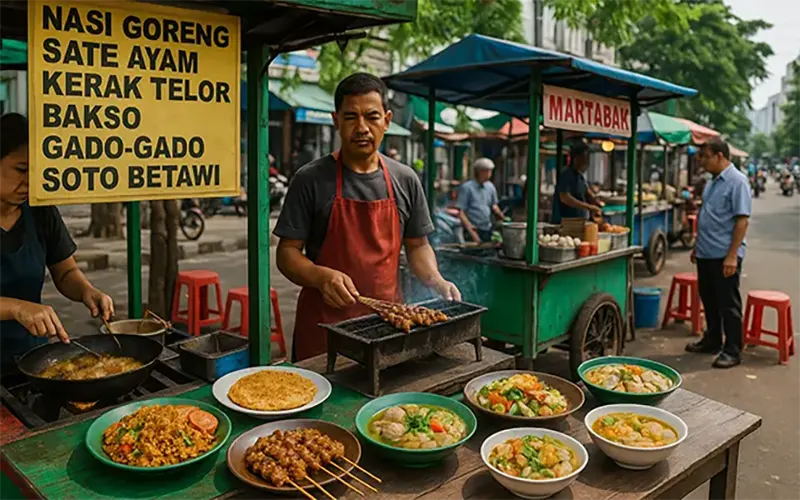
Jakarta is a city that assaults the senses in the best way possible. It is hot, it is loud, and the traffic is legendary. But cut through the humidity and the exhaust fumes, and you will find the true perfume of the city: the smell of charcoal smoke fanned over grilling chicken, the sizzle of woks hitting high heat, and the sweet aroma of roasting dough.
For the uninitiated, Jakarta can feel intimidating. The city is a sprawling megalopolis of 10 million people, a melting pot of cultures from across the Indonesian archipelago. While the gleaming malls of Grand Indonesia or Plaza Senayan offer air-conditioned comfort and international chains, the soul of Jakarta lives on the street.
The street food vendors, known locally as Kaki Lima (literally “five legs,” referring to the three wheels of the cart plus the two legs of the vendor), offer some of the most complex, flavorful, and authentic food in Southeast Asia.
If you are visiting Jakarta for the first time, do not be afraid to step out of your hotel restaurant. With a little knowledge and a sense of adventure, the streets of Jakarta offer a culinary experience you will never forget.
The Golden Rules of Street Food Safety
Let’s address the elephant in the room: hygiene. Many tourists worry about “Bali Belly” (or in this case, “Jakarta Belly”). While caution is healthy, fear shouldn’t stop you from eating. Follow these rules to eat safely:
- Follow the Crowds: The number one rule of street food is turnover. If a stall has a line of locals waiting, the food is moving fast, ingredients are fresh, and it hasn’t been sitting out.
- Heat is Your Friend: Only eat food that is cooked in front of you. You want to see the steam rising. Avoid dishes that look like they have been sitting in a display window at room temperature for hours (like Nasi Campur buffets) unless you are there right at lunch rush.
- Water Wisdom: Never drink tap water. Stick to bottled water or sealed drinks. When it comes to ice, most established street vendors now use commercially produced ice (tubes with holes in the middle), which is safe. However, if the ice looks like chipped blocks, it’s safer to skip it.
- The “Pedas” Factor: Indonesian food can be incredibly spicy. If you have a sensitive stomach, say “Tidak pedas” (not spicy) or “Sedikit pedas” (a little spicy). Sometimes, it’s not the bacteria that upsets a tourist’s stomach, but the sheer amount of chili!
The “Big 3” National Icons
These dishes are famous across Indonesia, but Jakarta offers some of the best versions you will find anywhere.
1. Nasi Goreng (Fried Rice)
You cannot visit Indonesia without eating Nasi Goreng. But in Jakarta, you want to look for the “Tek-Tek” carts—named after the sound the vendor makes hitting his wok with a spatula to announce his arrival.
Jakarta street-style Nasi Goreng is different from the polite version served in hotels. It is smokier, cooked on a high-pressure stove, and often darker due to a generous amount of Kecap Manis (sweet soy sauce).
- Pro Order: Try “Nasi Goreng Gila” (Crazy Fried Rice). This is a Jakarta specialty where the rice is topped with a stir-fry of sausages, meatballs, scrambled eggs, and veggies, all tossed in a savory, spicy sauce.
2. Sate (Satay)
Forget the dry appetizers you get in Western restaurants. Jakarta street satay is a main event. You will smell the smoke before you see the cart. Vendors use hand-held fans to keep charcoal embers glowing hot, searing the meat quickly to keep it juicy.
- Sate Ayam (Chicken): Served with a savory peanut sauce and Lontong (compressed rice cakes).
- Sate Kambing (Goat/Lamb): A favorite in Jakarta. Unlike chicken, this isn’t usually served with peanut sauce, but rather with Kecap Manis, sliced shallots, tomatoes, and bird’s eye chilies to cut through the richness of the meat.
3. Martabak
The undisputed King of Indonesian Night Snacks. Martabak stalls usually open only after 6:00 PM. There are two distinct types, and you need to try both:
- Martabak Manis (Sweet): Think of a thick, honeycomb-textured pancake folded in half. The classic filling is chocolate sprinkles, crushed peanuts, and condensed milk, but modern versions include Nutella or matcha. It is heavy, buttery, and sinful.
- Martabak Telur (Savory): A crispy, fried dough parcel filled with a mixture of duck eggs, ground beef, and green onions. It is deep-fried in a flat wok until golden and crunchy.
The Jakarta Specials (Betawi Flavors)
Jakarta is the home of the Betawi people, the indigenous ethnic group of the city. Their cuisine is a unique blend of Malay, Chinese, Indian, and Arab influences. To truly taste Jakarta, you must find these Betawi dishes.
4. Soto Betawi
While every region in Indonesia has a soup (Soto), Soto Betawi is the richest and most decadent. The broth is a creamy mixture of beef stock, coconut milk, and often cow’s milk, seasoned with nutmeg, cloves, and lemongrass.
It typically contains chunks of beef brisket and sometimes offal (you can ask for just meat or “daging saja” if you prefer). It is served with rice, lime juice, and Emping—slightly bitter crackers made from melinjo nuts that cut perfectly through the creamy soup.
5. Kerak Telor (The Spicy Omelet)
This is perhaps the most traditional Betawi snack, often found at cultural sites like Kota Tua (Old Town) or Monas (The National Monument).
Vendors sit on the ground with small woks over charcoal braziers. They mix glutinous rice, duck egg, Serundeng (spiced toasted coconut), and dried shrimp. The mixture is cooked until it forms a crust (Kerak), then the wok is flipped upside down over the coals to smoke the top. It has a unique texture—crispy on the outside, sticky on the inside, with a deep, savory, smoky flavor.
6. Ketoprak
If you are looking for a lighter or vegetarian-friendly lunch, Ketoprak is the answer. It is a salad consisting of fried tofu, steamed rice cake (Lontong), rice vermicelli, and bean sprouts.
The magic is in the sauce. The vendor will grind garlic, chili, and peanuts fresh on a stone mortar plate, mix it with water and sweet soy sauce, and pour it over the dish. It is finished with a mountain of Kerupuk (garlic crackers).
Where to Find Them: The Best Food Streets
You can find food carts on almost every corner, but these two locations are legendary hubs that are relatively easy for tourists to navigate.
1. Jalan Sabang (Central Jakarta) Located right behind the Sarinah building and near the National Monument, Jalan Sabang comes alive at night. It is a long strip of unmatched variety.
- What to eat here: This is the best place to find excellent Nasi Goreng and Sate. It is bustling, safe, and frequented by office workers and tourists alike.
2. Blok M – “Gultik” (South Jakarta) In the Blok M area, specifically near the intersection of Jalan Mahakam and Jalan Bulungan, you will find a phenomenon called Gultik (short for Gulai Tikungan or “Curry at the Corner”).
- What to eat here: Dozens of vendors sell exactly the same thing: a small portion of beef goulash (curry soup) with rice served on a banana leaf. It is incredibly cheap, savory, and the ultimate late-night comfort food.
Practical Tips for the Street Food Warrior
- Cash is King: Street vendors do not take credit cards. Carry small denominations (Rp 5,000, 10,000, and 20,000 notes). A meal will typically cost between Rp 20,000 and Rp 40,000 ($1.50 – $3.00 USD).
- Dining Etiquette: Seating is often on plastic stools or long benches shared with strangers. It is polite to eat quickly if there is a line.
- “Bungkus”: If you are too hot or tired to sit on the street, say “Bungkus” (wrap it up/takeaway). Street food vendors are masters of packaging food to go.
Jakarta’s traffic might test your patience, but its food will win your heart. So, grab a bottle of water, find a busy stall with a cloud of aromatic smoke, and dig in. Selamat makan!