
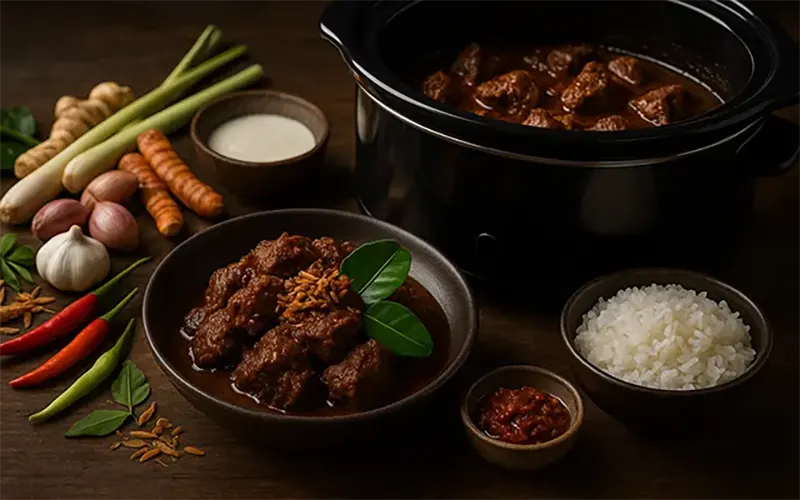
If you ask any Southeast Asian culinary expert what the crown jewel of Indonesian cuisine is, the answer is almost universally the same: Beef Rendang.
It’s a dish that transcends mere sustenance. Hailing from the Minangkabau ethnic group of West Sumatra, Rendang is a cultural icon, frequently topping global lists of the “world’s most delicious foods.” It is intensely aromatic, deeply savory, spicy, and features beef so tender it practically dissolves on the tongue.
Traditionally, achieving this nirvana of flavor requires immense patience. It involves standing over a hot wok over a wood fire for four to six hours, constantly stirring coconut milk until it completely evaporates, leaving the meat to fry in its own residual spicy oil.
In a modern, busy kitchen, spending six hours hovering over a stove isn’t always feasible. But does that mean you have to miss out on authentic flavor? Absolutely not.
By utilizing the slow cooker for the heavy lifting and employing a crucial finishing technique, we can achieve a Rendang that is authentic in flavor and texture, with significantly less active cooking time.
Here is how to make authentic Indonesian Beef Rendang using a modern slow cooker hack.
It’s Not a “Curry”: Understanding Real Rendang
Before we touch the slow cooker, we need to understand what we are trying to achieve.
In the West, Rendang is often mistakenly categorized as a “wet curry.” In Indonesia, however, true Rendang is technically a preservation technique. The process starts with meat swimming in spicy coconut milk (the gulai stage), cooks down into a thick, rich gravy (the kalio stage), and finally, the liquid evaporates entirely.
At this final stage, the coconut milk breaks, releasing its oil. The meat then fries in this seasoned oil, turning dark brown, intensely caramelized, and “dry.” This process not only concentrates flavor to incredible levels but also allowed the dish to travel for days without refrigeration in the tropical heat.
The Slow Cooker Compromise
This evaporation process is where the slow cooker presents a challenge. Slow cookers are designed to trap moisture, not evaporate it. If you leave Rendang in a slow cooker for 8 hours, you will have a delicious beef stew, but you will not have authentic Rendang.
Here is the secret: We use the slow cooker to perfect the tenderization process—the long, slow braise that breaks down tough connective tissue. Once the meat is butter-tender, we must transfer the dish to a stovetop wok for a final, high-heat reduction to achieve that signature caramelized finish.
This hybrid method gives you the authentic result without the six-hour vigil at the stove.
The Essential Ingredients
Rendang relies on a complex marriage of fresh aromatics. Do not try to substitute dried powders for fresh roots; the flavor profile will be flat.
- The Beef: You need a cut with fat and connective tissue that loves long cooking. Beef Chuck (braising steak) cut into large 2-inch chunks is ideal. Lean cuts like sirloin will turn into dry leather.
- The Aromatics: This is the soul of the dish. You will need fresh Lemongrass (serai), fresh Galangal (lengkuas—this has a distinct piney, citrus scent that ginger cannot replicate), and fresh Turmeric.
- The Leaves: Kaffir Lime Leaves (daun jeruk) provide the unmistakable citrus backbone. If you can find a Turmeric Leaf, it adds an authentic grassy note, though it is optional.
- The Coconut Milk: Use full-fat, quality canned coconut milk or cream. Do not use “lite” versions; you need the fat for the final frying stage.
- The Secret Weapon: Kerisik (Toasted Coconut Paste): This is non-negotiable for texture and a nutty, deep flavor. It is simply grated fresh coconut that is dry-toasted in a pan until golden brown and then pounded into an oily paste. You can buy this ready-made in Asian grocers, or make it quickly yourself.
The Recipe: Hybrid Slow Cooker Beef Rendang
Prep time: 30 minutes Cook time: 6-8 hours (Slow Cooker) + 45 minutes (Stovetop finish)
Ingredients:
- 2 lbs (1 kg) Beef Chuck, cut into 2-inch cubes
The Spice Paste (Bumbu) – Blend until smooth:
- 10-12 dried red chilies (soaked in hot water to soften), or fresh red chilies for less heat.
- 8 shallots, peeled and roughly chopped.
- 5 cloves garlic.
- 2 inches fresh ginger.
- 2 inches fresh galangal (or 1 tbsp galangal paste).
- 1 inch fresh turmeric (or 1 tsp turmeric powder).
- 1 tbsp coriander seeds, toasted and ground.
The Pot Aromatics:
- 2 stalks lemongrass, white part only, bruised heavily with a mallet.
- 6 kaffir lime leaves, roughly torn to release oils.
- 1 turmeric leaf, tied in a knot (optional).
- 1 cinnamon stick.
- 2 star anise pods.
Liquids and Seasoning:
- 2 cans (approx. 800ml) full-fat coconut milk.
- 2 tbsp palm sugar (gula jawa), grated, or dark brown sugar.
- 1 tsp tamarind paste dissolved in 2 tbsp warm water.
- 3 tbsp Kerisik (toasted coconut paste).
- 1.5 tsp salt (adjust to taste later).
Instructions:
Phase 1: The Slow Cooker Braise
- Prepare the Beef: Pat the beef cubes dry. There is no need to sear the beef beforehand; it will brown during the final stage.
- Combine: Place the beef chunks into the basin of your slow cooker. Pour the blended spice paste (bumbu) over the meat. Add the bruised lemongrass, torn kaffir lime leaves, turmeric leaf, cinnamon stick, and star anise.
- Liquids: Pour in the coconut milk, tamarind water, palm sugar, salt, and the Kerisik.
- Mix and Set: Stir everything thoroughly to ensure the beef is coated.
- Cover and cook on LOW for 7–8 hours, OR HIGH for 4–5 hours.
- Check Tenderness: The beef should be fork-tender but not completely falling apart into shreds. There will still be a significant amount of liquid in the pot.
Phase 2: The Authentic Stovetop Finish (Crucial Step)
- Transfer: Carefully transfer the entire contents of the slow cooker (meat, sauce, and aromatics) into a large, wide wok or a heavy-bottomed Dutch oven.
- The Reduction: Place the wok over medium-high heat. Bring the liquid to a vigorous simmer. You want to evaporate the water rapidly. Stir occasionally to prevent sticking.
- The Thickening (Kalio Stage): After about 20-30 minutes, the sauce will thicken into a rich, dark gravy. It will start to splatter, so be careful. Lower the heat slightly to medium.
- The Frying (Rendang Stage): Continue cooking and stirring frequently. You will notice oil starting to separate from the thick sauce, pooling around the edges. This is the coconut oil breaking away.
- Caramelize: Keep stirring gently as the meat fries in this oil. The sauce will cling to the meat and turn a dark chocolate brown color. The dish is done when there is almost no sauce left, only shiny, dark meat and separated reddish oil.
Pro Tips for the Best Experience
- The Patience Rule: Like many complex stews, Rendang tastes significantly better the next day. The flavors have time to meld and deepen into the meat. If you can manage it, cook it a day ahead, refrigerate it, and reheat it gently on the stove.
- Remove Aromatics: Before serving, fish out the hard lemongrass stalks, cinnamon stick, and star anise. The lime leaves can be eaten.
- Serving: Serve with heaps of plain steamed white rice to balance the intense richness. A side of cool cucumber slices is traditional to cleanse the palate.